Your AI Tool Fails the Moment You Need It Most: Rethinking Connectivity Assumptions in Public Safety Technology
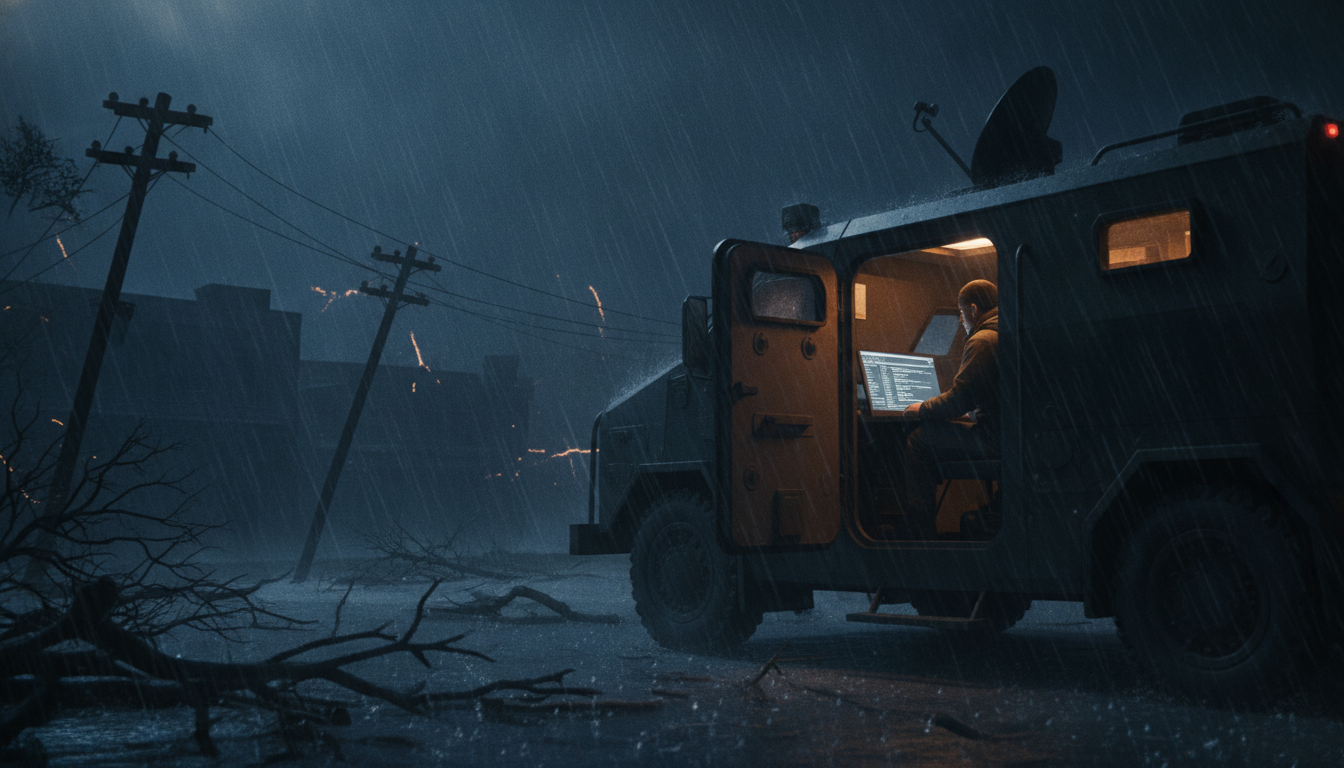
An AI tool that depends on a distant cloud server will stop working the moment a major disaster severs the network infrastructure it relies on; which is precisely the moment emergency services need decision support most. The answer is offline AI for emergency management using edge computing: language models running on local hardware inside the EOC or on apparatus, available whether or not the internet is.
Key takeaways
Cloud-dependent AI tools fail during the large-scale incidents they are most needed for, because those incidents destroy the connectivity the tools require.
Edge-local AI models running on hardware you control, keeps working when the network does not, without sending incident or patient data outside your perimeter.
Local models on modest hardware are genuinely less capable than frontier cloud models; the design discipline is matching the right task to the right tier.
Retrieval over your own plans and SOPs, summarization, structured drafting, and transcription-class work run well at the edge; deep open-ended reasoning does not yet.
Procurement and policy decisions made before an incident determine whether your AI capability survives it.
Why does cloud AI fail at the worst possible moment?
In an earlier article on building a private AI memory system on inexpensive local hardware, we walked through the practical mechanics of running a language model entirely within your own environment. That piece focused on data sovereignty and cost. This one focuses on what happens when the power grid buckles, cell towers go down, and your agency's cloud-hosted AI tool goes silent; because that sequence is not a hypothetical. It is the documented pattern of every significant natural disaster of the last two decades.
Hurricanes, major wildfires, extended ice storms, and widespread flooding share a common signature: they degrade or destroy exactly the infrastructure that cloud computing depends on. Fibre lines are cut. Cell towers lose commercial power and exhaust generator fuel. Satellite bandwidth becomes contested and unreliable under surge demand. The public internet, which feels permanent in daily operations, becomes intermittent or unavailable for days at a time. Anyone who has commanded through a multi-day Atlantic Canada winter storm knows the feeling of watching connectivity flicker out right as operational complexity peaks. The AI tool in your browser goes to a loading spinner and stays there.
This is not a vendor criticism. It is a structural problem with the architecture. A model that lives in a data centre in another province or state cannot reach your EOC when the pipe between you is broken. The tool is not malfunctioning; it simply does not exist locally. And because most commercial AI platforms were designed for always-on enterprise environments, the failure mode is often invisible until it happens in the field.
What does edge-local AI actually mean for emergency services?
Edge computing, in this context, means running the AI model on hardware that is physically present in your environment — a dedicated server in the EOC, a ruggedized workstation on a mobile command unit, or a small form-factor machine on the apparatus. The model operates entirely locally. It does not make outbound calls to process your queries. It answers from its own weights and from whatever documents you have loaded into its retrieval layer: your SOPs, your pre-incident plans, your mutual aid agreements, your COOP documentation.
Resilience is the first and most direct benefit. A local model keeps working when the network does not. There is no dependency on external uptime, no API rate limit during surge demand, no vendor outage to ride out. The operational calculus is the same as the one that drives every other degraded-mode practice in emergency services: you train for the conditions you will face at worst, not the conditions you enjoy on a routine day.
Sovereignty is the second leg. Incident data, patient data, personnel data, and tactical information should not leave your control; not because cloud vendors are careless, but because the jurisdictional, regulatory, and ethical case for keeping that data local is clear. When the model runs on your hardware, the data never traverses a network you do not own. That matters under privacy legislation, and it matters operationally when the information is sensitive.
Latency and availability under degraded conditions form the third argument. Even when connectivity is technically present but severely degraded; low bandwidth, high packet loss, satellite with variable latency; cloud AI tools become frustratingly slow or unreliable. A local model responds in the same time whether the internet is healthy or broken, because it is not using the internet at all.
Cost predictability is the fourth consideration, and it matters for public sector budget cycles. Cloud AI tools typically charge per token or per query, which means costs scale with use and are difficult to forecast. Local hardware is a capital expense with a predictable lifecycle. For agencies that cannot absorb unpredictable operating costs, that structure has real administrative value.
What are the honest tradeoffs of running AI at the edge?
Credibility requires saying this plainly: local models running on modest hardware are meaningfully less capable than the frontier models available through cloud APIs. The gap is real and it matters for certain tasks. Deep, open-ended reasoning over novel problems, synthesis across large and diverse bodies of knowledge, and complex multi-step analytical work currently favour the larger cloud models. Agencies that expect edge hardware to replicate that capability will be disappointed.
The design discipline, therefore, is right-sizing the task to the tier. There is a class of work that runs well at the edge and that emergency services genuinely need during a degraded-connectivity incident: retrieval over your own documentation, summarization of situation reports, structured drafting of operational orders or resource requests, transcription of radio traffic, and question-answering over your own plans. These tasks are bounded, well-defined, and do not require the model to know everything — they require it to know your materials, reliably, offline. That is achievable with current local model technology on hardware that does not require a data centre budget.
The pattern that makes the most operational sense is hybrid by design. Edge-first for everything that must survive the storm. Cloud when connectivity is available, to access greater capability for tasks that can wait for it. Synchronization when connectivity returns, to update local knowledge bases and log decisions made offline. This is not a novel architectural concept; it mirrors the way good software systems have handled intermittent connectivity for years. What is new is applying it deliberately to AI capability in emergency services, and building procurement and policy frameworks that reflect it.
How does this connect to how responders trust AI under pressure?
As a PhD candidate in Systems Design Engineering (Human Factors) at the University of Waterloo, the question driving my doctoral research is how responders calibrate trust in AI decision support when conditions are degraded and stress is high. The degraded-connectivity scenario sharpens that question considerably. A system that is less capable offline must communicate its own limitations clearly and honestly, or it will be trusted most exactly when it deserves it least. A responder who does not know the model is operating on a reduced capability set; no internet, smaller model, narrower retrieval; may weight its outputs more heavily than the situation warrants. That is a human factors failure built into the system design, and it is preventable.
This is not just theoretical for us. We are building a platform for emergency services on exactly these principles: edge-first architecture, honest capability communication, and human factors baked into the design rather than added as an afterthought.
What procurement and policy decisions close the gap?
The practical question for emergency management leaders and public safety technology decision-makers is what to require before signing a contract or deploying a tool. The answer starts with a simple stress test: does this system work when there is no internet? If the honest answer is no, the next question is whether that is acceptable for your risk profile. For many routine administrative uses, cloud-only tools are fine. For tools intended to support active incident management, the answer should be no.
Procurement language matters. Requiring vendors to document their offline functionality — or lack thereof — creates accountability and forces an honest conversation before acquisition rather than during a crisis. Policy matters too: agencies should designate which AI capabilities are mission-critical during extended outages and ensure those capabilities are available locally. That designation drives architecture decisions and budget allocations before a storm season begins, not during one.
Emergency services train for degraded modes in communications, in logistics, in command and control. The standard should be no different for AI tools. If your people will reach for a tool under pressure, they need to know it will be there.
If you are evaluating how your agency's current or planned AI infrastructure would hold up under extended connectivity loss, our executive briefing on private AI architectures for public safety walks through the design considerations in a format built for leadership, not IT procurement alone. You might also find value in our free AI Readiness Assessment, which helps agencies identify where connectivity assumptions are creating unexamined gaps in their technology plans.
Frequently asked questions
Can a local AI model really run without any internet connection?
Yes. Several open-weight language models are designed to run entirely on local hardware without any outbound network calls. Once the model weights are downloaded and the retrieval layer is loaded with your documents, the system operates independently of internet connectivity. The tradeoff is capability: local models on modest hardware are less powerful than frontier cloud models, so the task design needs to reflect that honestly.
What kinds of tasks are practical for offline AI in an EOC?
Tasks that are bounded by your own documentation work well: searching and retrieving content from your SOPs, pre-incident plans, mutual aid agreements, and COOP materials; summarizing situation reports; drafting structured operational documents; and transcription-class work. Tasks requiring broad open-ended reasoning or synthesis across large external knowledge bases are better suited to cloud access when it is available.
How does a hybrid edge-cloud architecture work in practice?
The edge layer handles all AI tasks locally during connectivity outages. When internet access is restored, the system can optionally use cloud APIs for tasks that benefit from greater capability and are not time-critical. Synchronization on reconnection updates the local knowledge base with any new documentation and logs decisions made offline. The key design requirement is that the system degrades gracefully; it keeps working when connectivity drops, rather than failing completely.
Is local AI deployment affordable for smaller agencies?
Hardware costs for local AI deployment have dropped significantly as smaller, efficient model architectures have matured. A capable local deployment does not require enterprise server infrastructure. That said, there are real costs in hardware, setup, and maintenance that should be evaluated honestly against the agency's risk profile and budget constraints. Cost predictability; knowing your AI capability costs the same whether you use it heavily or lightly; is one of the operational advantages compared to consumption-based cloud pricing.
What is the human factors risk of degraded-mode AI operation?
The primary risk is miscalibrated trust: a responder who does not know the system is operating with reduced capability may rely on its outputs more heavily than is appropriate. Good system design addresses this by making the operational mode visible and explicit; the interface should communicate clearly when it is operating offline and what that means for its capabilities. Designing that transparency in from the start, rather than treating it as an afterthought, is a core human factors requirement for any AI tool intended for high-stakes use.