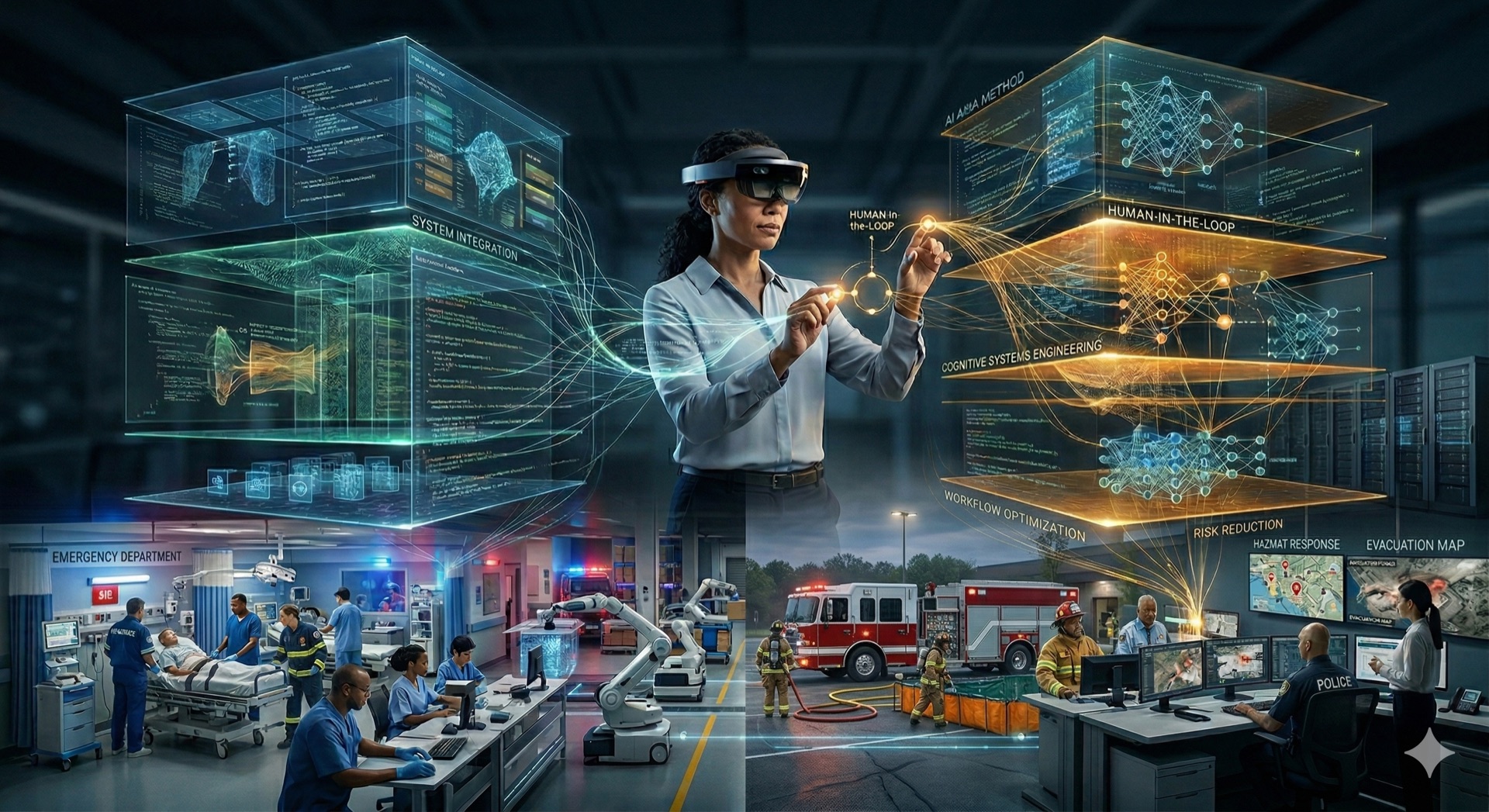
Human factors for high-consequence work
We build safer systems to help humans.
People aren't the problem. They're the solution we build around.
We work with fire and paramedic services, dispatch and public safety, healthcare, government and corporations: anywhere people make hard decisions under pressure, inside systems designed for how the work is imagined rather than how it is done. We design the job, the rules and the tools around the people who do the work.
Learning from a serious event? Start with After the Call
For fire, paramedic and healthcare services, public safety, government, and any organization that wants to learn from events the way the best emergency services do. Grounded in published human factors and safety science.
The practice
Safety. Systems. Healthy humans.
One science runs through all three: human factors, the study of how people, technology and organizations actually work together. Every engagement starts from the same question: how is the work really done, and how do people decide when it matters? Thirty years in the field keep the methods honest.
Safety
A service that learns.
The problem
A bad call, a near miss or a serious event, followed by a review that finds a person, takes a year and changes nothing.
What you get
After the Call, our free method for learning from incidents, near misses and good catches. Courses that teach it. An expert read of your own review. An independent learning review when an event needs outside eyes. A gap analysis against the standard you are held to.
Systems
Work designed around the people who do it.
The problem
Plans, policies, workflows and tools written for the work as imagined. AI arriving in dispatch centres, fire halls and hospitals before anyone decided where it belongs.
What you get
Organizational and readiness assessments, strategic and master plans, risk assessments, emergency plans and exercises. Workflow and tool redesign built with the people who do the work. For AI: readiness, governance, procurement and implementation, and human-AI teaming designed so people trust the tool for the right reasons.
Healthy humans
Psychologically safe work, by design.
The problem
Burnout, psychological injury and turnover treated as the worker's weakness, and answered with a poster and a phone number.
What you get
A just culture people believe in. Learning teams instead of blame. Psychological health and safety built into the job, the schedule and the supervisor's practice, to the standard (CSA Z1003). Fatigue and workload assessed where the work is done. And for leaders in any sector, how to decide, lead and recover under pressure.
Systems · AI readiness, governance and implementation
AI your people can rely on, for the right reasons
The goal is appropriate reliance, not maximum trust. Lean on a tool too much and its errors pass unchallenged. Lean on it too little and it sits unused. Automation also changes the human's job, often in ways that make the hardest moments harder. Getting this right is a human factors problem before it is a technology problem.
Before you deploy
The decisions a tool will touch, how it can fail, what the people using it need to know, and a Do Not Touch list of where AI should not go.
Once it is running
Monitoring reliance, overrides and drift, so you know whether people trust the tool for the right reasons and problems surface early.
Governance that works on shift
Policies, accountability, procurement criteria and oversight that hold up on a busy night, not only in a report to council or the board.
After-Action Learning
After the Call
A practical way for fire, paramedic and healthcare services to learn from incidents, near misses and good catches, without turning the review into a search for someone to blame. The method is free. Our courses teach it.
The manual
A method your service can adopt: event triage, three tiers of review, a learning firewall, a model policy and templates. Free under a Creative Commons licence.
About the manual→The courses
Short, practical courses for joint health and safety committee members, safety officers, paramedic supervisors, quality leads and senior leaders. Certificate of completion.
See the courses→Support when you need it
An expert read of your own post-incident analysis, annual partner agreements, and independent learning reviews when an event needs outside eyes.
How reviews work→Who we work with
Four rooms, one question: how is the work really done?
Fire and paramedic services, dispatch and public safety
The work we come from. Learning from events, the first 72 hours after a bad call, and the tools arriving on the truck and in the dispatch centre.
Healthcare
Emergency departments, patient safety and quality teams, hospital-based paramedicine. Reviews that find the system, not a person.
Government
Emergency management, public safety ministries, municipalities and boards. Plans and governance that hold up on the night, not only in the report.
Corporations
Operations where a bad decision under pressure costs people or the business. Corporations bring in the military to talk about leadership under pressure. Emergency services live it every shift, and we built the systems behind it. We teach how to decide, lead and recover when it matters, then we fix the system so your people don't need to be heroes to get through a bad day.
Where to start
Where does your organization stand?
For AI
AI Readiness Assessment
A five-minute self-evaluation across six dimensions of readiness, with a personalized report on where to start and where to be careful.
Take the AI Readiness Assessment→For learning from events
Learning System Maturity Assessment
Thirty questions across six parts of a learning system, from near-miss reporting to follow-through on recommendations. Your results point to free resources first.
Take the self-assessment→Who we are
Two people, and the associates the work needs
The Human Factor is led by Scott Ramey. Scott brings thirty years in high-consequence systems: critical care flight paramedic, Deputy Chief in both paramedic and fire services, and Assistant Fire Chief. He is now a PhD candidate in Systems Design Engineering at the University of Waterloo, researching trust and appropriate reliance in AI-assisted decision support.
Dr. Umair Rehman brings human-centred systems: human-centred AI evaluation, human-AI interaction and cognitive engineering. Associates join when the work needs a specialist, and you always know who is doing the work.
“I lead every engagement myself, and I bring in associates when the work needs expertise beyond mine. Clients get one accountable person and the right people around them.”Scott Ramey, Principal
Published work
Before The Human Factor, Scott researched fatigue and equipment design with working paramedics. The practice still runs on that evidence.
- Ramey, S. D., MacQuarrie, A. S., Cochrane, A., McCann, I., Johnston, C. W., & Batt, A. M. (2019). Drowsy and dangerous? Fatigue in paramedics: An overview. Irish Journal of Paramedicine, 4(1). doi.org/10.32378/ijp.v4i1.175→
- Bitan, Y., Ramey, S., & Milgram, P. (2019). Ergonomic design of new paramedic response bags. Applied Ergonomics, 81, 102890. doi.org/10.1016/j.apergo.2019.102890→
- Ramey, S. D., Bitan, Y., & Philp, J. (2015, 2016). Human factors redesign of paramedic response bags, and a usability evaluation of the result. International Symposium on Human Factors and Ergonomics in Health Care, Baltimore and San Diego.
- The Human Factor (2026). After the Call: A method for learning from incidents, near misses and good catches. Manual, Creative Commons licence. Read the manual→
Start with a conversation
Thirty minutes, no charge. Tell us what you are working on: an AI tool you are weighing, a plan that has to hold up, an event you need to learn from, or a workplace that is burning people out. Please do not include personal health information or details that could identify a person or an event.